
Servala ISV Partnership
A fair, transparent partnership for jointly developing and delivering managed services — focus on your expertise while we handle operations.
Why Partner with Servala?
Focus on Your Expertise
Concentrate on what you do best: service knowledge and development. We handle operations, provide the framework, and help you make the most of it.
24/7 Operations
Round-the-clock operational support, on-call organization, SLA management, and guaranteed availability, without building your own team.
Billing & Support
Access established billing, customer support, and infrastructure without the overhead.
Fair Revenue Sharing
Revenue sharing based on actual performance, not fixed rates. Equal margins in the long run.
Shared Risk
Risk is shared, not shifted. Higher early investments are paid back faster.
Servala Ecosystem
Reach new customers through the Servala platform and growing partner network.
How It Works
A fair, transparent partnership for jointly developing and delivering managed services via the Servala platform.
VSHN (MSP) Responsibilities
- Service ownership (operations, code)
- Billing and end-customer contracts
- 1st Level Support
- 24/7 support with on-call organization
- Service instance operation (SLA)
- Servala Portal development & operation
ISV Responsibilities
- Market knowledge for the service
- Service knowledge (specialists)
- 2nd Level Support
- Ongoing service maintenance
- Upgrades and security response
- Best practice configuration
Shared Responsibilities
Support Structure
Clear escalation paths ensure end-users get the right level of expertise for their needs.
1st Level Support
Handled by VSHN
Initial contact for all end-user requests. Ticket handling, triage, known issue resolution, basic configuration questions, and status inquiries.
2nd Level Support
Handled by ISV
Escalation for complex, service-specific issues requiring deep expertise. Architecture, best practices, performance optimization, and service-specific bugs.
3rd Level Support
Vendor Escalation
For issues requiring upstream vendor involvement, typically involving core product bugs or feature requests.
Revenue Sharing Model
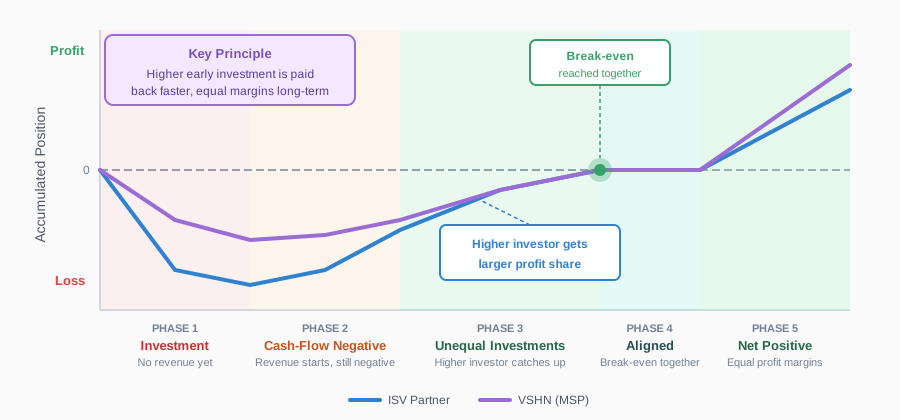
Revenue distribution adapts dynamically to the financial state of the service, ensuring fairness at every stage of the partnership.
Calculation Basis
Cost calculation is based on effective hourly labor costs, not customer billing rates with profit margins. The service earns its profit through instance sales. This approach ensures a transparent cost basis.
Investment Phase
Both partners invest: one-time initialization costs, monthly fixed costs, and variable costs per instance. No revenue generated yet.
Cash-Flow Negative
Service is live but not profitable. Revenue is split proportionally to each partner's monthly costs.
Unequal Investments
Monthly revenue exceeds costs, but one partner has higher cumulative losses. All profit goes to that partner until losses equalize.
Aligned Investments
Cumulative losses are balanced. Profit is split 50/50. Both partners reach break-even at roughly the same time.
Net Positive
All investments paid back. Revenue is split proportionally to current monthly costs. Both partners achieve equal profit margins.
Why This Model is Fair
Higher Investments Paid Back Faster
Whoever takes more early risk gets their investment back faster, without being overcompensated in the long run.
Equal Margins Long-Term
After payback, profit scales proportionally to ongoing costs. Both partners achieve the same relative margin.
Risk is Shared, Not Shifted
No partner bears disproportionate loss risk; no one profits from miscalculated assumptions.
Fairer Than Static Models
This model always covers real costs first and only distributes profit when it actually exists.
Deliverables
VSHN Delivers to ISV
- AppCat framework development & maintenance
- Training for AppCat framework
- Code and documentation review
ISV Delivers to VSHN
- Service implementation with AppCat
- Service architecture & documentation
- Operations runbook engineering
- Training for 1st level support
- Continuous service development
Practical Collaboration
Transparency & Reporting
Both partners maintain open exchange on costs and efforts. Expected initial efforts and ongoing costs are agreed upfront. Quarterly comparison and adjustments. Monthly revenue reporting.
Adaptability
Since distribution is driven by actual numbers, the model can be reviewed regularly (quarterly) to validate assumptions and adjust pricing or go-to-market strategy if needed.
Term & Flexibility
Partnership starts with a 12-month minimum term from go-live. After that, either party can terminate with 3 months' notice. Extraordinary termination remains possible for serious issues.
Next Steps
Initial Conversation
Discuss your service, market positioning, and partnership goals.
Technical Assessment
Review your service architecture and integration with AppCat framework.
Partnership Agreement
Define responsibilities, cost structures, and revenue sharing terms.
Go-Live
Launch your managed service on the Servala platform.
Partnership Summary
Costs are covered first. Risk is shared fairly. Higher investments are paid back faster. Long-term profits are distributed proportionally and transparently.
Ready to Get Started?
Subscribe to our newsletter to stay informed.