Furniture, not lumber: Tobias Brunner on why Europe needs a marketplace for sovereign cloud services
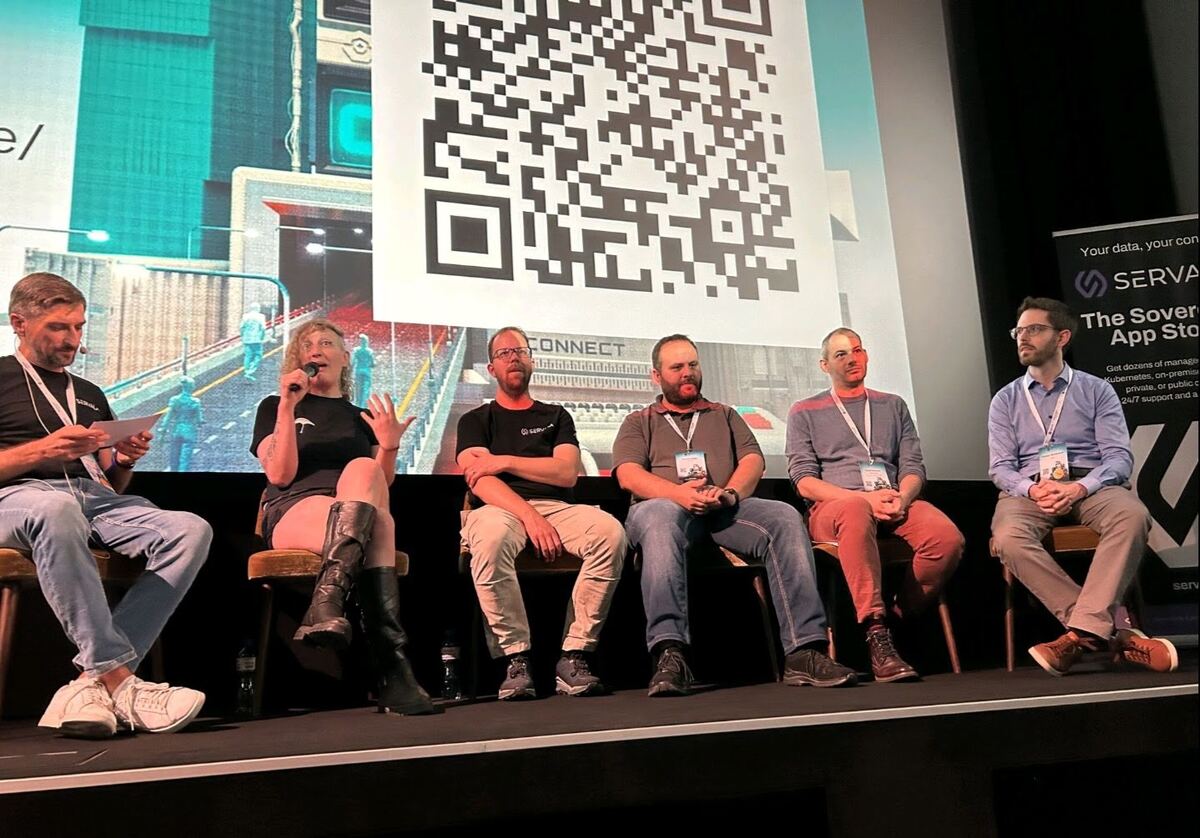
What do sausages, furniture and airplanes have to do with digital sovereignty? At DINAcon 2026 on November 18th in Bern, Tobias Brunner answered that question in his talk "Furniture, Not Lumber" (watch the recording) and used it to explain why Servala exists.
Finished products vs. raw parts
Furniture, airplanes and sausages have one thing in common: you buy them as finished products. Hardly anyone buys the ingredients to make their own sausage or the materials to build their own airplane.
Digital services are different. With most European and Swiss cloud providers, ordering a service feels more like buying lumber than furniture. You get an empty virtual machine, an empty Kubernetes cluster, some storage and networking, and then you have to put it all together yourself. Teams wanted to work on an application project and end up with a platform project instead.
Carpenter, catalogue or marketplace
Tobias described several ways to get your digital furniture:
The carpenter: You get exactly what you want, but it takes time, costs more and doesn't scale. This is like building your own infrastructure.
The catalogue: You choose from predefined options and can adjust a few details. This is how most cloud services are bought today.
IKEA: One big store with everything in it, one checkout, fast and easy, but everything is made by IKEA. This is the hyperscaler model. Building a new IKEA from scratch takes a lot of time and money. Germany's STACKIT is trying to do this, and it shows how hard it is.
The marketplace: Galaxus started with its own warehouse and today also lets other sellers offer their products. Sellers reach many customers, and buyers find everything in one place.
What Airbus teaches us
In the 1970s, Boeing and McDonnell Douglas dominated commercial aviation, and no single European country could compete on its own. Europe's answer was to pool the work: several countries built the parts, and Airbus became the final assembly line where everything came together into a finished airplane. Airlines didn't want to buy the parts from different suppliers and build their own aircraft. They wanted a finished product. Today, Airbus is the world's largest aircraft manufacturer.
According to Tobias, the parts for this already exist in Switzerland and Europe: good cloud providers and managed service providers, skilled people, and open source software for almost every need. But open source on its own is still lumber. Someone has to run it, take care of it and sign the contracts. And the pieces are scattered, so they're hard to find. What's missing is the marketplace. Digital sovereignty isn't a single product, it's a market structure.
Servala: a federated hyperscaler
That's the idea behind Servala. Tobias describes it as the Galaxus of IT infrastructure and managed services, or a "federated hyperscaler":
Cloud providers supply the infrastructure: virtual machines, Kubernetes clusters, storage.
Software vendors and open source communities supply the software.
Managed service providers run the services, carry the SLA and get up at night when something breaks.
Customers order everything in one place and get one bill.
Behind the scenes, the work is shared among many vendors. For the customer, it looks like it all comes from one place, much like an airplane coming off the assembly line. And the service goes to the data, so you don't have to copy your data to a service in another country.
Servala is live today.
And the sausage? In Swiss German, Servala sounds a lot like Cervelat.
Let's build the store together
Tobias closed with three messages:
No one can beat the hyperscalers alone. There isn't enough money or time to build something that big from scratch, so the work has to be pooled.
If you run a service, put it in a catalogue where it can be found.
If you buy services, ask for the finished product, not the lumber.
Watch the talk
The full recording of Tobias' talk is on YouTube: Furniture, Not Lumber - Tobias Brunner at DINAcon 2026
OpenSovereign launched the same day
Tobias' call to work together wasn't the only one that day. On the morning of DINAcon 2026, five independent Swiss IT companies launched OpenSovereign, a new Swiss alliance for digital independence: VSHN, Puzzle ITC, Adfinis, cloudscale and Cyberlink. Together they cover the full stack, from cloud infrastructure and connectivity to platforms, managed services, applications, secure collaboration and AI. The idea is that organizations should be able to choose, stay and move freely, without vendor lock-in.
The first public OpenSovereign slide was shown in Aarno Aukia's talk on the eight dimensions of sovereignty, which followed later that day.
Find out more at opensovereign.ch, in the launch announcement and in the DINAcon 2026 recap on the VSHN blog.